Protective Clothing Standards
EN Standards:
Personal Protective Clothing
EN ISO 13688 – PROTECTIVE CLOTHING
General Requirements
This European standard specifies the general requirements for protective clothing including requirements for ergonomics, safety, size designation, compatibility, ageing and protective clothing marking as well as the information that has to be supplied by the manufacturer with protective clothing.
The EN ISO 13688 standard must only be used when combined with other standards that have specific protection requirements and not autonomously.
This standard replaces EN 340.
EN 342 – PROTECTIVE CLOTHING
Ensembles And Garments For Protection Against Cold
This European standard specifies the requirements and test methods for protective clothing that aim to protect against cold (not including garments for head, hands and feet). However, sufficient protection must be worn along with a thermal base layer for this certification to apply. The EN 342 standard is related to clothing designed for protection in cold environments ranging from chill (-5° C) through to cold store (125° C) to deep freeze (-40° C).
The EN 342 standard is determined by four parameters as detailed below:
a. Thermal insulation properties with motion
b. Thermal insulation properties without motion
c. Air Permeability (1-3)
d. Waterproof penetration properties
Clothing according to this standard is marked with the below pictogram.

EN 343 – PROTECTIVE CLOTHING
Garments For Protection Against Rain
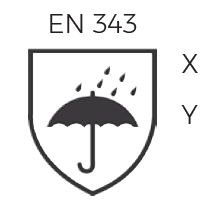
This European Standard specifies the requirements and test methods for materials and seams on protective clothing that is used for protection against precipitation (e.g. rain and snowflakes), fog and ground humidity. Materials and seams are tested for water penetration resistance before and after pre-treatment as well as for water vapour resistance.
Protective clothing according to this standard is marked with the pictogram shown below and information about the level of protection.
X indicates the level for water penetration resistance. The water penetration resistance is expressed in Wp. There are three classes, class 1, 2 and 3. Class 3 is the best class, class 1 the lowest.
Y indicates the level of water vapour resistance. The water vapour resistance is expressed in Ret. There are three classes, class 1, 2 and 3, where 3 is the highest class and 1 the lowest. Clothing with class 1 should only be worn in a limited period depending on the surrounding temperature.
EN 14605 – PROTECTIVE CLOTHING
Garments For Protection Against Liquid Chemicals
This European standard specifies minimum requirements for protective clothing used for partial protection of the body against liquid chemicals. The requirements apply to the properties of the materials used for the garment and not for the finished garment. All the properties tested obtain a class afterwards. All tests are made after 5 x wash. This standard also specifies requirements for the design of the different kinds of
clothing.
Protective clothing according to this standard is marked with the below pictogram:
This standard replaces EN 467.
EN 13034 – PROTECTIVE CLOTHING
Garments For Protection Against Liquid Chemicals
This standard specifies the test methods and requirements to protective clothing which are intended for use in cases of a potential low-risk exposure, e.g. a light spray, liquid aerosols or low pressure, low volume splashes, against which a complete liquid permeation barrier is not required.
Chemical protective suits (Type 6) forms the lowest level of chemical protection and is intended to be used if risks have been assessed as low and a full liquid permeation barrier is not necessary, i.e. when wearers are able to take timely adequate action when their clothing is contaminated. The construction of seams of all chemical protective clothing shall prevent penetration of liquid through stitch holes or through other components of a seam and not obstruct run-off of the liquid.
Protective suits that fulfill the requirements of an EN 13034 are marked with the pictogram below.
Following chemicals are tested under EN 13034:
– 30% aqueous solution of H2S04
– 10% aqueous solutions of Na0H
– O-Xylene (undiluted)
– Butan-1-ol (undiluted)
EN ISO 20471 – HIGH VISIBILITY CLOTHING
High Visibility Warning Clothing For Professional Use
This international Standard specifies requirements for high visibility clothing which is capable of visually signaling the user’s presence. High visibility clothing is grouped into three classes related to risk assessment. Garments shall comprise the required areas of background material and retroreflective material or alternatively shall comprise the required area of combined performance material. The area shall be measured on the smallest garment size available with all fasteners adjusted to the smallest configuration possible. Each of these classes will provide a different level of conspicuity, class 3 being the class that provides the highest degree of conspicuity against most backgrounds found in urban and rural situations in daylight and night time. The garment shall be made up of high visibility materials on all sides. To ensure visibility from all sides (360° visibility), it is important that horizontal retroreflective bands and fluorescent materials encircle torso, trouser legs and sleeves.
The performance class can be obtained using a single garment or a clothing ensemble, e.g. jacket and trousers. An assembly e.g. a classified trouser and a classified jacket, can be classified as an higher class if the assembly meets the minimum requirement achieved by the actually visible area when wearing the garment. This higher class shall be additionally specified in both the information for use and on the labels of both garments. Regardless of the area of materials used, a class 3 garment shall cover the torso and shall have either long sleeves with retro reflective bands or a full length trouser legs with retroreflective bands, it not both.
The minimum visible area requirements to achieve a garment classification are not to be reduced or compromised due to the presence of any logos, lettering, labels etc. Classification must be stated by a graphical symbol.
The number next to the graphical symbol (x in the figure) indicates the garment class. Besides this the EN ISO 20471 also contains requirements to the constructions of materials such as colour fastness, mechanical strength and retroreflective properties.
This standard replaces EN 471.
EN ISO 11611 – PROTECTIVE CLOTHING
For Use In Welding & Allied Processes
This standard describes the test methods as well as the minimum requirements for protective clothing that aim to protect the wearers body during welding and allied processes. The standard does not include protective clothing for hands, head and feet (except hoods and gaiters).
The clothing aim to protect the wearer against molten metal splashes, brief flame contact, radiant heat and accidental contact with voltage up to 100V d.c. in normal conditions of welding. The clothing is tested for resistance to flame spread, molten metal splashes, heat transfer (radiation) and electrical resistance and is divided into 2 classes after test, class 1 or 2, where class 2 offers the best protection.
The standard is marked with the below diagram and the class achieved:
EN ISO 11612 – PROTECTIVE CLOTHING
Clothing To Protect Against Heat And Flame
This European Standard specifies the requirements and test methods for clothing that is intended to protect the wearer against heat and flame. This standard includes requirements for limited flame spread. Test is made according to procedure A and/or B and the test method used is listed as A1 or A2 together with the pictogram.
Requirements for heat resistance are also part of this standard and the following properties are tested:
– Protection against convective heat – the level reached is listed as B1, B2 or B3 (B3 best and B1 lowest)
– Protection against radiant heat – the level reached is listed as C1, C2, C3 or C4 (C4 best and C1 lowest)
– Protection against molten aluminium splashes – the level reached is listed as D1, D2 or D3 (D4 best and D1 lowest)
– Protection against molten iron splashes – the level reached is listed as E1, E2 or E3 (E3 best and E1 lowest)
– Protection against contact heat – the level reached is listed as F1, F2 or F3 (F3 best and F1 lowest)
The protection level of each property is listed together with the pictogram.
Besides the above requirements, this standard also comprises requirements for the design, innocuousness, and for the mechanical properties like for instance tear strength. The standard also includes tests of optional properties,
for instance test of waterproofness according to EN 343. The result of this test is marked at the pictogram with the letter W followed by the achieved class.
Clothing according to this standard is marked with the pictogram below:
EN ISO 14116 – PROTECTIVE CLOTHING
Protection Against Heat and Flame
Limited Flame Spread Materials, Assemblies & Clothing
This standard replaces EN 533 and specifies the requirements for protective clothing with limited flame spread properties. Clothing according to this standard is intended to protect against sporadic and brief contact with open fire in cases where no heat hazard of any kind exists.
Clothing according to this standard is marked with the below pictogram:
Tests of the following properties are made: flaming debris, after glow, hole formation and after flame. After test the clothing is classified into index 1, 2 or 3, where index 3 offers the best protection and index 1 the lowest.
The clothing is also provided with a cleaning index that inform about which cleaning procedure the clothing have been exposed to before test.
The cleaning index is listed together with the flame spread index in the following way:
EN 14116/Index 1+2+3/°C x number of washes/type of wash
This standard also comprises requirements for the design of the clothing, tensile strength, tear strength and seam strength.
EN 1149 – PROTECTIVE CLOTHING
Electrostatic Properties
This European standard includes a series of standards that describe test methods and requirements for the electrostatic properties of protective clothing.
The standard specifies the requirements for design and materials for protective clothing that aim to protect the wearer against incendiary discharges. The requirements may not be sufficient in oxygen enriched flammable atmospheres.
EN 1149-1: Test method for measurement of surface resistivity
EN 1149-2: Test method for measurement of the electrical resistance through a material
EN 1149-3: Test method for measurement of charge decay
EN 1149-4: Test of clothing (in preparation)
EN 1149-5: Material performance and design requirements
Protective clothing where the properties of the materials are taken into account are marked EN1149-3.
Protective clothing where the properties of the materials as well as the design are taken into account are marked EN 1149-5.
Protective clothing according to this standard is marked with the below pictogram:
EN 61482 – PROTECTIVE CLOTHING
Protection Against Thermal Hazards Of An Electric Arc
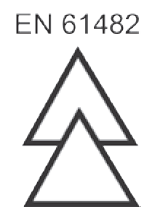
This European standard consists of two parts that each describes two test methods that are used to test materials and protective clothing that aim to protect against the thermal hazards of electrical arcs.
Method 1, listed as EN 61482-1, is used to determine the arc performance value of flame resistant materials used for clothing. The result from this method is called the ATPV (arc thermal performance value) and is expressed as kW * s/m². The ATPV of the material indicates how much thermal energy a material can withstand before the wearer will suffer 2nd degree burns.
Method 2, also called the box test, listed as EN 61482-1-2, is used to determine the arc rating of flame resistant material and clothing. The test classifies the materials/clothing into two classes, class 1 (4 kA) or 2 (kA), where class 2 offers the highest level of protection.
Protective clothing according to this standard is marked with the below pictogram: